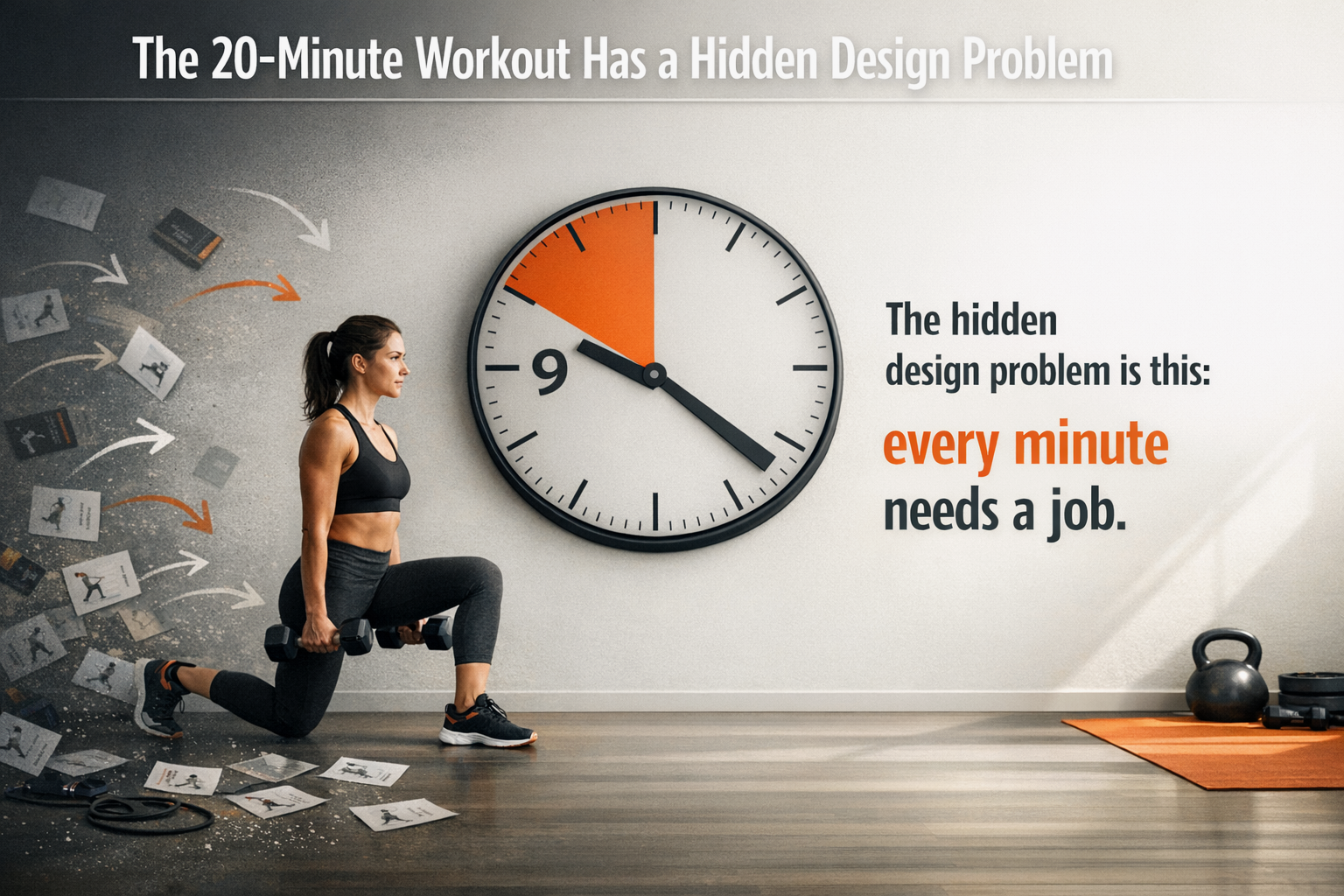
The 20-Minute Workout Has a Hidden Design Problem
A short workout doesn’t automatically become efficient just because it lasts 20 minutes.
In fact, many “express” workouts are poorly designed. They include too many exercises, too many transitions, too much explanation, or an intensity level that leaves the person drained before the workday has properly started. The workout may look busy from the outside, but busyness isn’t the same as useful training.
The hidden design problem is this: every minute needs a job.
That doesn’t mean every minute has to be brutally intense. It means each part of the session should support what comes next. The preparation should make the focused work more effective. The focused work should create the main training stimulus. The finish should help the person leave the workout ready for the day rather than feeling as though they’ve started a second job before breakfast.
A 20-minute workout works best when it’s designed as a sequence, not a collection.
The mistake is measuring time instead of purpose
When people build a short workout, they often start with a time limit and then try to squeeze as much activity as possible into it.
They might choose six exercises because six feels more complete than three. They might add several circuits because they’re worried the workout won’t be “enough.” They might switch between floor exercises, standing exercises, bands, weights, and mobility drills without noticing how much time is lost moving between them.
The result can be a session that feels active but lacks direction.
There’s another problem too. A short workout often gets made harder simply to compensate for being short. That can mean moving too quickly, using too much resistance, reducing rest too aggressively, or choosing movements that create unnecessary fatigue. The person finishes exhausted, interprets exhaustion as proof of quality, and then struggles to repeat the session consistently.
But the purpose of a morning workout isn’t to win a contest against the clock. It’s to create a useful training effect while protecting the rest of the day.
A better question than “How many exercises can I fit into 20 minutes?” is:
What does this minute need to accomplish?
That question changes the design immediately.
The first minutes may need to raise body temperature, improve movement quality, and prepare the joints for the work ahead. The middle needs to focus on the primary objective, such as strength, conditioning, or full-body movement. The final minutes need to bring the session to a deliberate close.
This gives you a simple way to assess any short workout: preparation, focused effort, finish.
If one of those stages is missing, the workout may still be difficult, but it’s probably not well designed.
The three-part test for a useful 20-minute session
The preparation stage answers one question: “Is the body ready to perform the main work?”
Preparation shouldn’t become a separate workout. It doesn’t need ten mobility drills or an elaborate sequence that requires its own instruction manual. It should help the person move into the main work with better control and less friction.
For a morning session, that may involve simple movements that gradually increase range of motion and effort. A few controlled bodyweight squats, alternating reverse lunges, shoulder movements, light marching, or slow hinges may be enough, depending on the session. The exact exercises matter less than the function: the person should feel more prepared after the preparation, not tired from it.
The focused effort is where the workout earns its place on the calendar.
This section should have a clear job. If the goal is strength, the main work should allow the person to use controlled resistance and repeat quality movement. If the goal is general fitness, the session might combine several large movement patterns at a manageable pace. If the goal is to wake up before deep work, the emphasis may be on purposeful movement without creating unnecessary depletion.
The mistake is trying to make the focused section achieve every possible goal at once.
A 20-minute workout can be useful without containing strength, mobility, maximum conditioning, balance training, core work, and every major movement pattern in the same session. Trying to cover everything often produces a shallow version of each objective.
The finish is the part people often ignore.
They simply stop when the timer ends, grab their phone, and move directly into email. But the final minutes can determine how the workout fits into the rest of the morning. A finish might include slower movement, breathing, light stretching, or a brief walk around the room. It can also create a practical transition into the workday by giving the person a moment to notice how they feel before rushing into demands.
The finish doesn’t need to be dramatic. It needs to prevent the workout from ending abruptly.
A useful repeatable rule is:
The preparation earns quality. The focused effort creates the stimulus. The finish protects repeatability.
That’s the design logic behind a sustainable short workout.
What this looks like for a busy entrepreneur
Consider Maya, who runs a small consulting business and wants to exercise before her first client call at 9:00 a.m.
She has 20 minutes between getting ready and opening her laptop. Her original routine includes jumping jacks, squats, push-ups, mountain climbers, lunges, planks, band rows, high knees, and stretching. On paper, it looks comprehensive.
In practice, she spends time deciding what to do next, changing positions, adjusting the resistance band, checking the timer, and rushing through the final exercises. Some mornings she finishes feeling energized. Other mornings she feels overstimulated and flat during her first meeting. After a demanding week, she skips the routine because it feels too difficult to restart.
The problem isn’t that Maya lacks motivation. The problem is that the workout has no clear allocation of responsibility.
A better version might look like this:
For the first four minutes, Maya performs a simple preparation sequence. She begins with controlled marching, bodyweight squats, hip hinges, and shoulder movements. The goal isn’t to tire herself out. It’s to move gradually and prepare for the main work.
For the next 12 minutes, she uses three exercises that cover the largest useful patterns for her available equipment: a squat or sit-to-stand variation, a push movement, and a row or hinge movement. She performs them in a repeatable sequence, using a pace that allows her to maintain control. Instead of changing exercises every 30 seconds, she stays with the same small group long enough to settle into the work.
For the final four minutes, she reduces the pace. She walks slowly, takes controlled breaths, and performs a few comfortable stretches. Then she writes down one sentence about how she feels before beginning work.
Notice what changed. The revised session may appear less impressive because it contains fewer movements. But it has more usable structure.
Maya doesn’t have to make decisions during the workout. She doesn’t waste energy transitioning between unrelated exercises. She can tell whether she’s ready to increase the challenge because the main movements are consistent. She also has a better chance of finishing the workout in a state that supports her first client call.
The workout has become easier to repeat without becoming meaningless.
That distinction matters. A short workout shouldn’t be judged only by how hard it feels while it’s happening. It should also be judged by what it allows the person to do afterward and whether they can realistically perform it again.
Use the “friction audit” before adding intensity
Before making a 20-minute workout harder, inspect where time and attention are being lost.
Ask:
- How many times does the person need to change position?
- How many equipment changes are required?
- Are the exercises arranged in a logical order?
- Does the person know exactly what to do next?
- Is the preparation long enough to improve movement but short enough to preserve energy?
- Does the main section have one dominant purpose?
- Does the ending help the person transition into the day?
These questions reveal a common pattern: people often try to solve a design problem with more intensity.
If the session feels ineffective because the exercises are poorly sequenced, adding speed won’t fix it. If the workout feels boring because there’s no clear progression, adding more exercises won’t fix it. If the person feels depleted afterward, shortening rest further may make the problem worse.
Sometimes the best improvement is not a new movement. It’s removing two movements, placing the exercises in a better order, or creating a clear stopping point.
You can also use a simple “minute ownership” test. Look at the workout and assign each block a sentence:
- “These minutes prepare me to…”
- “These minutes are meant to improve…”
- “These minutes help me finish by…”
If you can’t complete those sentences clearly, the workout probably contains activity without enough design.
This test works beyond exercise selection. It helps determine whether the workout belongs in the morning at all. A demanding conditioning session may be appropriate before a less intense workday, but poorly suited to a morning filled with presentations, travel, or high-stakes decision-making. The right workout depends partly on what the person needs to preserve after training.
That’s why the same 20-minute structure can be adjusted without becoming random. The sequence stays stable, while the emphasis changes.
On a day when Maya has a long strategy workshop, she might keep the main work controlled and moderate. On a day when her schedule is lighter, she might increase resistance or make the focused section more challenging. The preparation and finish remain familiar, which reduces decision-making and helps the routine remain recognizable.
The goal isn’t to make every morning identical. It’s to make every morning understandable.
A well-designed short workout should answer three questions before the timer starts:
What am I preparing for? What is the main work? How do I want to feel when I’m done?
If the answer to the first question is “nothing specific,” the preparation is probably unnecessary or too elaborate. If the answer to the second is “a little bit of everything,” the session probably needs a clearer priority. If the answer to the third is “completely exhausted,” the workout may be designed around discomfort instead of usefulness.
The most effective 20-minute workout isn’t the one that makes the morning feel heroic. It’s the one where every minute supports the next minute, the next task, and the next opportunity to repeat the session.
Before adding another exercise, run the minute-purpose test: What job is this minute doing, and what would be lost if I removed it? If the answer isn’t clear, remove the exercise, simplify the transition, and give the time back to the part of the workout that matters most.
Try This With AI
Use the AI you’re already using: ChatGPT, Claude, Gemini, Grok, Meta AI, Copilot, or another general-purpose AI assistant. Replace the example information inside the brackets with your own information, then copy and paste the complete prompt into your AI.
AI Prompt Audit the workout or exercise routine I provide and redesign it into a practical 20-minute morning session where every minute has a clear job. Infer my likely goal, available space, equipment, experience level, and constraints from my description, and clearly label any important inference you make. Organize the session into preparation, focused effort, and finish. Remove unnecessary exercise variety, reduce avoidable transitions, give the focused section one clear primary purpose, and choose a sensible intensity that supports repeating the workout without leaving me unnecessarily depleted for the rest of the day. Preserve useful movements when possible, but explain what you removed, combined, reordered, or replaced and why. Then provide the finished minute-by-minute session, transition instructions, a simple way to judge whether the intensity is appropriate, and a “minute-purpose test” showing what each block is meant to accomplish. Do not invent medical guidance, guaranteed results, or unsupported claims. Here is my current routine and situation:
[Paste or describe your current workout, available equipment and space, typical morning schedule, work or activity that follows it, and any limitations. Example: “I have 20 minutes before my first client call at 9:00 a.m. I train at home with a mat and resistance bands. My current routine includes jumping jacks, squats, push-ups, mountain climbers, lunges, planks, band rows, high knees, and stretching, but I often rush, lose track of what comes next, and feel drained before work.”]
Available on Amazon:
EXPRESS WORKOUT SYSTEM: 20-MINUTE TRAINING FOR BUSY PROFESSIONALS